
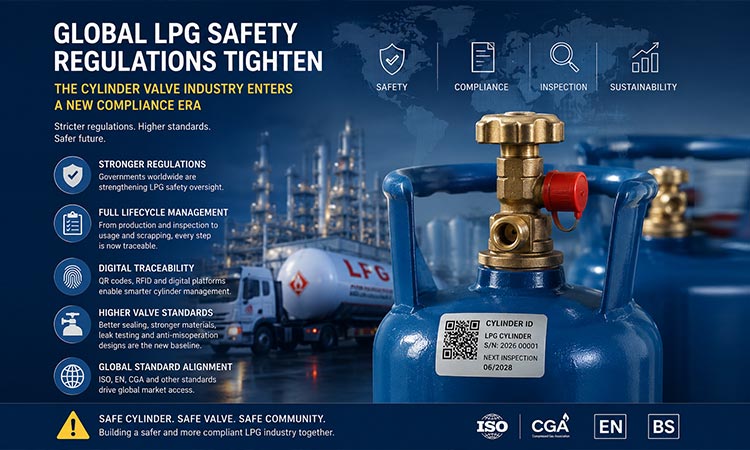
Over the past decade, competition in the LPG industry has largely focused on pricing, production capacity, and distribution networks. However, a significant shift is now taking place across global markets:
LPG regulation is moving from basic equipment compliance toward full lifecycle safety management.
In 2026, multiple regions including China, the Middle East, India, and Southeast Asia have continued strengthening safety supervision for LPG cylinders, valves, and related gas control systems. In some markets, authorities are already promoting:
* Digital traceability systems
* Mandatory inspection cycles
* Cylinder identification management
* Enhanced valve safety standards
China’s newly updated TSG 92—2026 regulation further emphasizes:
* Cylinder valve safety management
* Emergency shut-off requirements
* Lifecycle inspection procedures
* Scrap and traceability systems
At the same time, regulators in developing LPG markets are increasing oversight on:
* Illegal cylinder modifications
* Expired cylinders in circulation
* Valve leakage risks
* Non-standard valve connections
This trend reflects a broader industry reality:
LPG safety is no longer viewed as only an equipment issue — it is increasingly treated as a public safety issue.
In densely populated areas, a single valve leakage or cylinder-related incident can quickly escalate into a large-scale safety accident. As a result, global regulatory priorities are changing rapidly.
In the past:
* Low cost was often the priority
* Basic functionality was sufficient
* Procurement focused mainly on short-term pricing
Today, the market increasingly demands:
* Traceability
* Inspection capability
* Long-term operational safety
* Standardized compliance
For cylinder valve manufacturers, these regulatory changes are already reshaping customer expectations.
More buyers are now paying attention to:
* Sealing reliability
* Service life performance
* Corrosion resistance
* Leak testing data
* High- and low-temperature stability
* Anti-misoperation safety design
rather than simply comparing unit prices.
Another emerging trend is the gradual introduction of digital cylinder management systems.
Some overseas markets have started exploring:
* QR-code tracking
* RFID identification
* Digital cylinder databases
* Remote cylinder management platforms
In the future, cylinder valves may evolve from purely mechanical components into critical nodes within broader gas safety systems.
At the same time, international customers are placing greater emphasis on multi-standard compatibility, including:
* ISO
* CGA
* EN
* BS standards
For export-oriented manufacturers, relying on a single product specification is becoming increasingly difficult.
The LPG industry is gradually transforming from a traditional manufacturing sector into a highly regulated safety-equipment industry.
Going forward, long-term competitiveness will depend not only on:
* Manufacturing capability
* Certification systems
* Product testing capability
* Quality traceability
* Stable long-term supply consistency
As global governments continue strengthening energy and public safety regulations, the cylinder valve industry is entering a new era defined by higher standards, stricter compliance, and greater accountability.