
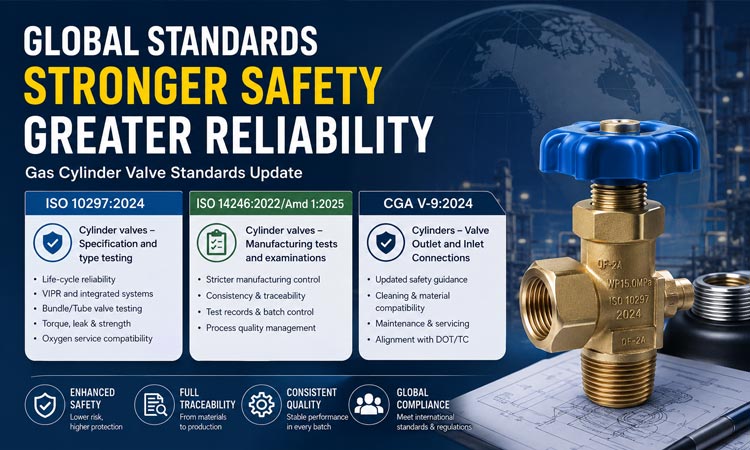
In recent years, global standards for gas cylinder valves have been undergoing significant updates.
What used to be a relatively straightforward mechanical component is now increasingly treated as part of a complete safety and gas management system.
The release of ISO 10297:2024 marked one of the most important revisions in the industry in the past decade. Compared with earlier versions, the new standard places greater emphasis on:
• Valve life-cycle reliability
• Oxygen service compatibility
• Torque consistency and leak prevention
• Integrated valve systems such as VIPR
• Testing requirements for bundles and tube systems
At the same time, ISO 14246 continues to strengthen manufacturing inspection and quality traceability requirements. Recent amendments show a clear trend: international markets are paying closer attention not only to valve design, but also to production consistency, testing records, and process control.
On the North American side, CGA V-9:2024 also introduced updated guidance related to valve safety, cleaning requirements, material compatibility, and maintenance practices.
These changes reflect a broader shift across the gas industry.
Today, customers are no longer evaluating cylinder valves only by pressure rating or basic sealing performance. Increasingly, they are looking at:
• Long-term operational safety
• Traceability and documentation
• Oxygen-clean manufacturing standards
• Stable batch quality
• Compliance with transportation and regulatory systems
For manufacturers, this means the industry is gradually moving from “component supply” toward “system-level reliability”.
As industrial gas applications continue to expand in medical, energy, beverage, and specialty gas sectors, standards will likely become even more detailed in the coming years.
Keeping up with these changes is no longer optional — especially for companies involved in international markets.