
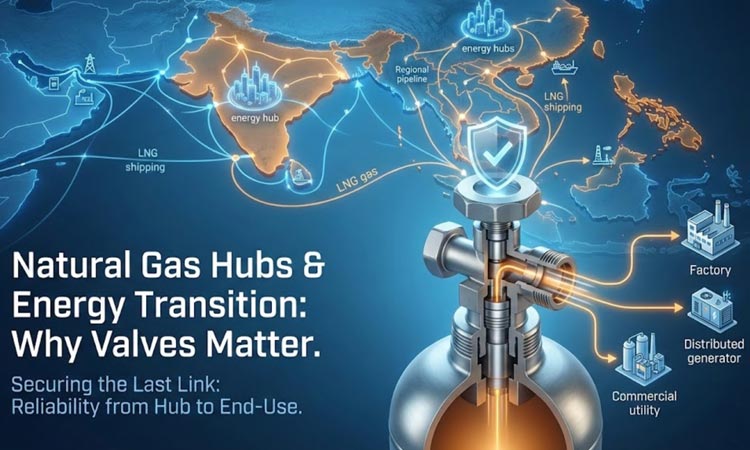
Why Cylinder Valves Matter More Than Ever
Natural gas continues to play a critical role as a transition fuel in South and Southeast Asia. Driven by the rapid expansion of gas-fired power generation, ongoing industrialization, and increasing LNG imports, regional demand for natural gas is expected to grow steadily over the next decade.
Much of the industry discussion today focuses on upstream supply, LNG infrastructure, and the potential development of regional gas trading hubs. However, behind these macro-level trends lies a more fundamental reality:
Every cubic meter of natural gas must ultimately be used safely, reliably, and under control at the point of consumption.
And this is where cylinder valves become essential.
Growing Natural Gas Demand Puts Pressure on End-Use Safety
As natural gas use expands across the region, its application scenarios are becoming more diverse and decentralized, including:
- Industrial manufacturing and processing
- Distributed energy and backup systems
- LNG storage, transportation, and regasification
- Commercial and utility gas supply
These applications share common characteristics: high operating frequency, long service life, and extremely low tolerance for failure.
While market discussions often center on price indices and supply security, system stability in practice depends on the reliability of each physical component — especially those directly responsible for gas containment and control.
Gas Market Integration Raises the Bar for Cylinder Valves
The gradual integration of regional gas markets and the increasing role of LNG introduce new technical challenges for downstream equipment:
1. More diverse gas sources and operating conditions
Natural gas from different origins may vary in pressure, composition, and purity. Valves must maintain sealing performance and structural integrity under a wide range of operating conditions.
2. Increased LNG handling and redistribution
LNG import terminals and downstream distribution systems rely on multiple stages of storage and pressure regulation. Reliable valve performance is critical to ensure safe transitions across these stages.
3. Stricter regulatory and compliance requirements
As cross-border gas trade grows, end-use equipment must comply with multiple standards, certifications, and inspection regimes. Consistency and traceability become increasingly important.
In this context, cylinder valves are no longer simple accessories — they are a critical part of the safety chain.
From “Functional” to “Reliably Functional Over Time”
In many emerging markets, cost and delivery speed were once the primary selection criteria for cylinder valves. However, as gas usage scales up and safety requirements tighten, buyer priorities are shifting.
The focus is moving toward:
- Long-term sealing reliability
- Stable performance under repeated operation
- Material suitability for different gas environments
- Consistent manufacturing quality
Failures at the valve level can result in disproportionate operational, safety, and reputational costs. As a result, reliability over the entire service life is becoming a decisive factor.
Chunhe’s Role: Securing the Last Link of the Gas System
Chunhe specializes in the manufacturing of cylinder valves for industrial gases and fuel gases, including natural gas-related applications. Rather than participating in market speculation or pricing narratives, Chunhe focuses on a clear and practical objective:
Ensuring that gas use at the terminal level remains safe, stable, and controllable.
In a rapidly evolving energy landscape, the true test of a gas system is not its theoretical efficiency, but its day-to-day operational reliability — valve by valve, cylinder by cylinder.
Conclusion: Energy Transition Depends on Stable Fundamentals
South and Southeast Asia’s natural gas market will continue to evolve, supported by infrastructure investment and regional integration. As this transition progresses, system complexity will increase — and so will the consequences of component-level failure.
Cylinder valves may be small in size, but they play an outsized role in ensuring safety and continuity across the gas value chain.
There are no shortcuts in energy transition — and none in safety.
Sustainable progress starts with reliable fundamentals.