
Safety, Compatibility, and Manufacturing Discipline
In industrial gas applications, cylinder valves are often treated as secondary components.
They are small, standardized in appearance, and rarely discussed unless something goes wrong.
However, in real-world gas systems, the cylinder valve frequently defines the actual safety limit of the entire system.
At Chunhe, we have spent years manufacturing cylinder valves for industrial gases, LPG, CNG, and related applications. From a manufacturing and application perspective, we believe that understanding the role of the valve requires moving beyond basic specifications and focusing on compatibility, consistency, and long-term reliability.
1. Cylinder Valves Are Not Just On–Off Devices
A common simplification is to view a cylinder valve as a mechanical switch — open or close.
In reality, a cylinder valve performs multiple critical functions simultaneously:
- Maintaining long-term sealing under repeated filling and discharge
- Managing pressure transitions safely and predictably
- Ensuring compatibility between gas media, materials, and sealing structures
- Acting as the final barrier between high-pressure gas and the external environment
Unlike many visible system components, valve-related issues often develop gradually.
Problems may not appear during initial installation or testing, but emerge after months or years of service due to wear, contamination, temperature cycles, or inconsistent machining.
For this reason, valve reliability is less about short-term performance and more about repeatability over time.

2. Gas Media Determines Valve Design — Not the Other Way Around
One of the most common misconceptions in the market is that cylinder valves can be broadly interchangeable as long as pressure ratings are similar.
From an engineering standpoint, this approach introduces unnecessary risk.
Different gases impose fundamentally different requirements:
- Oxygen demands strict control of material selection and cleanliness to avoid ignition risks
- Carbon dioxide requires sealing solutions that remain stable under low-temperature conditions caused by rapid expansion
- LPG and CNG involve flammable media, requiring robust structural design and controlled flow behavior
- Industrial gas mixtures introduce challenges related to long-term material compatibility and sealing integrity
These differences are rarely visible from the outside.
They are reflected in valve seat materials, internal sealing structures, flow path design, and machining tolerances.
A cylinder valve should be considered an integral part of the gas system, not a generic accessory.
3. Manufacturing Consistency Matters More Than Nominal Specifications
Datasheets describe design intent.
Manufacturing determines real-world performance.
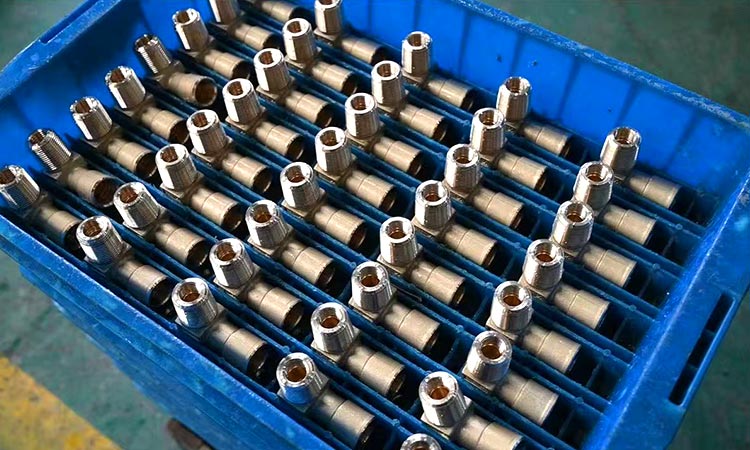
From the manufacturing side, we have learned that many valve issues are not caused by extreme conditions, but by small variations repeated over large quantities.
Three fundamentals are essential for reliable cylinder valve production:
Stable Machining Capability
Cylinder valves may appear simple, but they demand high precision in concentricity, thread accuracy, and surface finish. Even minor deviations can compromise sealing performance over time.
Clearly Defined Process Control
Critical steps affecting sealing and service life must be clearly identified and controlled. Relying solely on operator experience introduces variability that scales poorly with volume.
Batch-to-Batch Consistency
In gas applications, the true test is not whether one valve performs well, but whether every valve in a batch behaves the same way after long-term use.
In our experience, industrial gas customers value predictability far more than aggressive performance claims.
4. Reliability Is Built, Not Advertised
In the gas industry, failures are rarely dramatic at first.
They often start as minor leaks, unstable operation, or increased maintenance frequency — small signals that are easy to ignore until they accumulate into serious risk.
This is why valve manufacturing is ultimately an exercise in industrial discipline.
At Chunhe, our focus is not on exaggerated parameters or marketing language, but on ensuring that valves remain stable and reliable across large production volumes and long service cycles.
Because in gas systems, reliability is not a feature — it is a responsibility.
5. A Practical Approach to Cylinder Valve Manufacturing
With decades of experience in cylinder valve manufacturing, Chunhe supplies valves for oxygen, carbon dioxide, LPG, CNG, and other industrial gas applications.
Our approach emphasizes:
- Process stability over short-term optimization
- Compatibility with real-world gas usage conditions
- Manufacturing consistency across high production volumes
We believe that long-term cooperation in the gas industry is built on trust, and trust begins with components that perform quietly and consistently — without drawing attention to themselves.